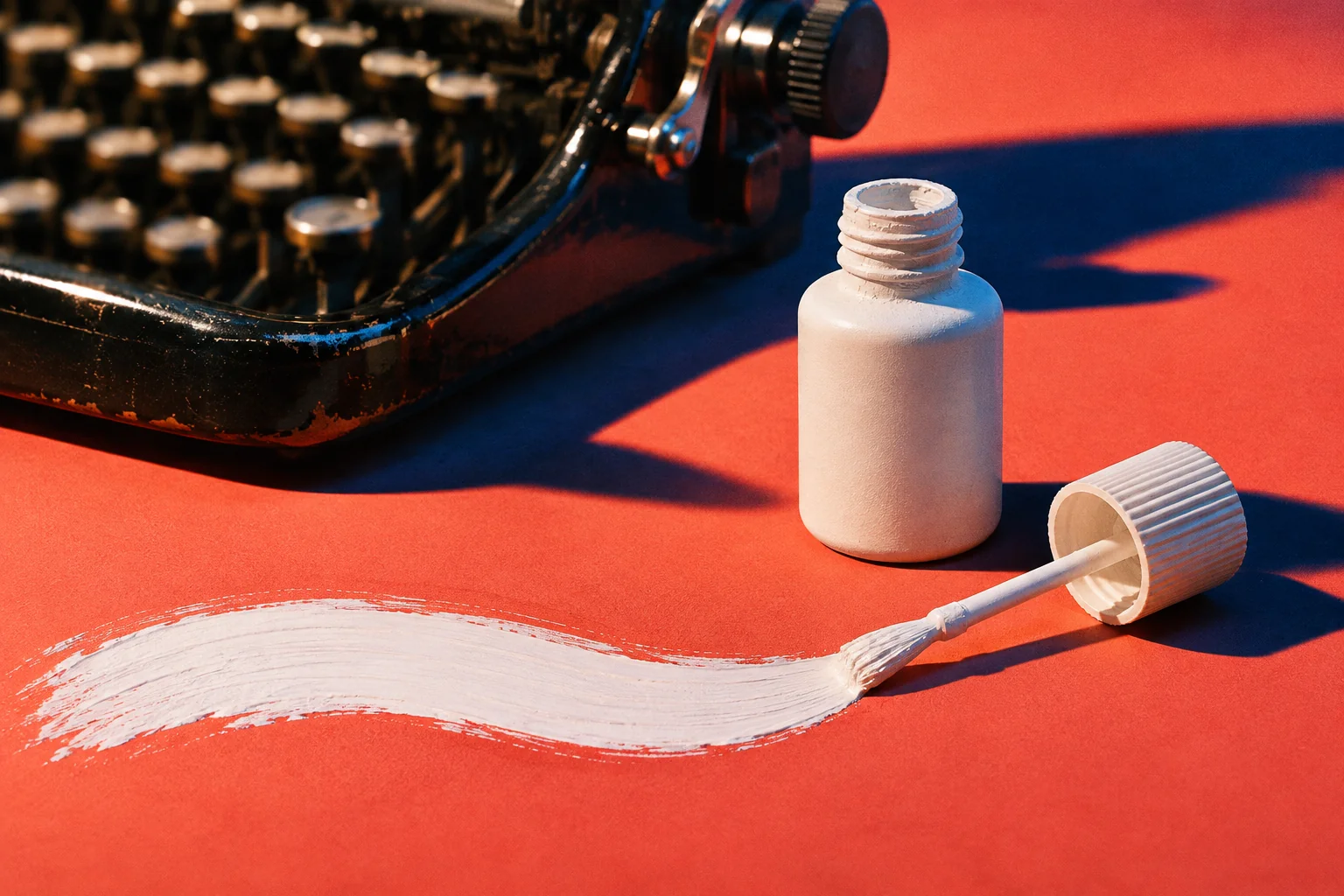
Before Liquid Paper became familiar office equipment, it was a way for a Dallas secretary to deal with a typing mistake. Bette Nesmith Graham worked at Texas Bank & Trust while raising her son. The electric typewriters entering offices could make correcting an error surprisingly difficult. [1]
A borrowed way of seeing.
Graham also painted. In that world, an unwanted mark could disappear under another layer of paint. She carried that possibility into her office work: mix water-based tempera paint to match the stationery, apply it with a small brush, and cover the error. A kitchen blender became part of her early production equipment. [2]
The connection seems almost obvious once someone has made it. Before that, painting and typing belong to different compartments of the day. Her useful move was to let knowledge from one activity cross into another.
There is something encouraging in the scale of that beginning. A troublesome mark on a sheet of paper was specific enough to investigate. The result could be tried immediately, in the place where the trouble occurred. It did not need an impressive introduction.
The untidy middle.
Other secretaries wanted the mixture. Graham began supplying bottles under the name Mistake Out. Her son and his friends helped fill them as the enterprise grew. By 1968, the company was selling a million bottles a year. [2]
The distance between those two scales contained substantial work. Graham sought help from her son’s chemistry teacher and an industrial polymer chemist to improve the formula. She sent samples, approached potential buyers, and faced rejection. IBM declined her attempt to interest it in marketing the product in 1957. The formula continued developing over years. [3]
Those details matter. An idea becomes more believable when its supporting work stays in the picture: people with different skills, repeated adjustments, customers with actual needs. Collaboration belongs inside the story of invention. So does the stretch when a promising thing still requires a day job, a sales effort, and another attempt at getting the material right.
What usefulness can grow into.
Graham’s attention eventually extended to the workplace she was building. Liquid Paper’s headquarters offered childcare and a library, and employees were encouraged to contribute to company decisions. She also established foundations supporting women. [1]
That gives the story a generous shape. The original product helped people recover from ordinary mistakes. The growing business created opportunities to consider other ordinary needs.
One useful way to read Graham’s story is to stay close to its beginning. Familiarity with a difficulty can provide valuable knowledge. A skill practiced elsewhere can supply an unexpected tool. The small improvement deserves attention while it is still small, before anybody knows what it might become.
What do you know from one part of your life that might help in another?
Follow the sources.
Historical details come from the sources below. Reflections and questions are editorial interpretation.
- National Women’s History Museum — Her working life, company practices, and foundations.
- Lemelson-MIT: Bette Graham — The painting connection, early production, and growth.
- United States Patent and Trademark Office — Chemistry collaborators, rejection, and sustained development.